
Plants of the Bible (1) Cedar, King of Trees
Plants of the Bible (1)
Cedar, King of Trees
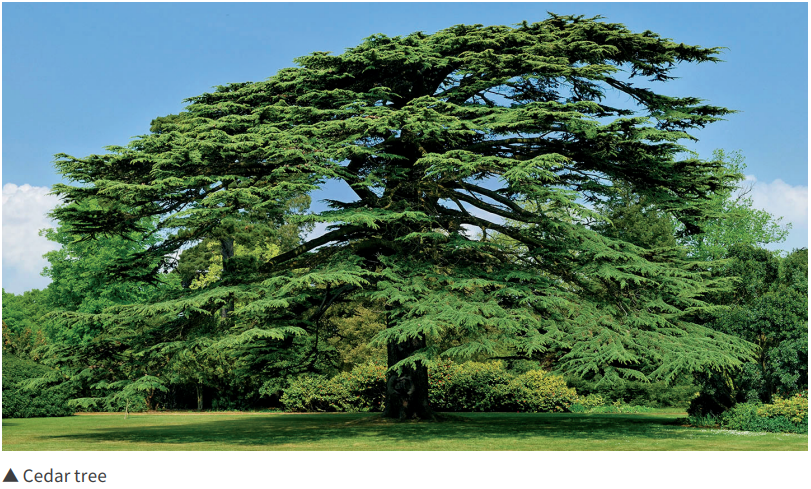
Who would be the richest person in the Bible? Excluding Jesus, the owner of all things, King Solomon would have been the richest man. But when you look at how the Bible expresses Solomon’s wealth, it states “The king made silver as common as stones in Jerusalem, and
he made cedars as plentiful as sycamore trees that are in the lowland” (1 Kgs 10:27; 2 Chr 1:15; 9:27, ref-Isa 9:10). Along with the silver used as currency at that time, cedar symbolized Solomon’s wealth.
Characteristics of Cedar
Mulberry was the most popular wood in Israel. Mulberry trees were very commonly spread throughout Israel (Amos 7:14-15; Luke 17:6, 19:2-4), and the growth rate was so fast that it could be used as a building material in six to seven years. Mulberry was affordable, light, durable, and resistant to rot, so it was used for most houses in Israel.
Compared to mulberry, cedar was a very difficult material to obtain. Cedar trees grow in the northern part of Israel, in the Lebanon region. To be more specific, even though it also could grow in other areas, it would grow small and unattractive, in poor condition. Only the cedar tree grown in Lebanon was so magnificent to be called “the king of trees”. Because of this, Israel had to import all its cedar wood.
The Lebanon region in northern Israel, including Mount Hermon, reaches altitudes of over 2,000 meters. The winters were bitterly cold, and the cold continued in other seasons. Cedar trees, as coniferous trees, grew really slowly due to the cold, only growing 1 to 2 cm per year. But because of its slow growth rate, it grew very solidly and straight, reaching up toward the sky. It would slowly but surely grow to nearly 40 meters, with a lifespan of 3,000 years. Thanks to these characteristics, cedar trees that have grown in a straight line and have grown for more than 100 years can be used as pillars on buildings simply by cutting the top and the bottom of the tree (1 Kgs 7:2-3;;, 2 Chr 2:8; ref-Song 5:15).
The cedar was so hard that nobody other than the inhabitants of Tyre and Sidon in Lebanon could cut them down (2 Sam 5:11; 1 Kgs 5:6). Even at the time of King Solomon, cedars were cut by the people of Sidon, woven into rafts, and transported by sea through the Mediterranean Sea (1 Kgs 5:9)
Cedar trees also have a unique subtle fragrance. When the wood was cut and the sap came out, it emitted a beautiful fragrance. According to scholars, cedar trees that have never been damaged would not emit a scent. But a damaged cedar would start the process of self-healing by producing sap, which would bring out its unique scent. This unique scent not calmed a person’s mind and body, but it also had antimicrobial and insect-repellent effects, which are connected to the lifespan of a building. In the Bible, the beautiful scent of the cedar was used as a symbol of grace, as well as being used to purify odor from sacrifices (Lev 14:4, 6,49-52).
Hosea 14:5-7 I will be like the dew to Israel; he will blossom like the lily, and he will take root like the cedars of Lebanon. His shoots will sprout, and his beauty will be like the olive tree and his fragrance like the cedars of Lebanon. Those who live in his shadow will again raise grain, and they will blossom like the vine. His renown will be like the wine of Lebanon.
Cedar Used in the Temple
Acacia wood was the most commonly used wood when building the tabernacle in the wilderness (Exod 25:10; 26:15, 32; 27:1+). Acacia wood was almost the only wood available in the wilderness, and it was very lightweight, making it suitable as a material for the tabernacle, which was repeatedly dismantled and assembled every time moved camp. However, when Solomon’s Temple was later built as a permanent structure in Jerusalem, the inner parts were clad and decorated with cedar overlaid with gold, so that no stone was visible (1 Kgs 6:9-10; 18-20).
1 Kings 6:18 There was cedar on the house within, carved in the shape of gourds and open flowers; all was cedar, there was no stone seen.
When rebuilding Zerubbabel’s temple after the destruction of Solomon’s temple, cedar was transported from Lebanon and used, through the decree of King Cyrus (Ezra 3:7).
Ezra 3:7 Then they gave money to the masons and carpenters, and food, drink and oil to the Sidonians and to the Tyrians, to bring cedar wood from Lebanon to the sea at Joppa, according to the permission they had from Cyrus king of Persia.
In the case of Ezekiel’s temple, there is no clear mention of which wood was used. Ezekiel 41:16-18 says, “The thresholds, the latticed windows and the galleries round about their three stories, opposite the threshold, were paneled with wood all around, and from the ground to the windows (but the windows were covered), over the entrance, and to the inner house, and on the outside, and on all the wall all around inside and outside, by measurement. It was carved with
cherubim and palm trees; and a palm tree was between cherub and cherub, and every cherub had two faces”. Here, “paneled with wood” is “sahip” (שָׁחִיף) in Hebrew, meaning “put up the wooden boards”. Additionally, the “table that was before the Lord” inside the sanctuary was also a wooden altar (Ezek 41:22), and the “threshold on the front of the porch” was also made of wood (Ezek 41:25).
Redemptive Historical Administration of the Cedar Tree
Cedar Imported through the Waterways of Tyre, A Foreign Land
In 1 Kings 5:8-11, Solomon imported cedar to build the temple and palace. All the lumber for building God’s temple was imported. The limestone of Jerusalem was very suitable for quarrying for construction purposes, and its color is so beautiful that it’s still used as one of the world’s best exterior building materials today. However, the interior materials used to decorate the inside of the temple were not from Jerusalem, but from the cedar trees that grew slowly in Lebanon
after enduring the severe cold.
This speaks of not only the outward beauty of the temple, but foreshadows the inclusion of the Gentiles in the redemptive history of completing God’s temple. Just as the temple used stones from Jerusalem and cedars from Lebanon in perfect harmony, the history of the Old Testament, which was conducted through the Jewish lineage, was completed through believing Gentiles in the New Testament era through Jesus Christ (Rom 11:11-14, 25).
Romans 2:28-29 For he is not a Jew who is one outwardly, nor is circumcision that which is outward in the flesh. But he is a Jew who is one inwardly; and circumcision is that which is of the heart, by the Spirit, not by the letter; and his praise is not from men, but from God.
Cedar, King of Trees
The cedar tree is called “the king of trees” because of its beauty. Even in the Bible, cedar trees are described as the most outstanding tree among all trees, and so beautiful that other trees envy it (Ezek 31:1-9)
The cedar tree was able to grow into an excellent tree only because God supplied the water and waited for it to grow. Psalm 104:16 says, “The trees of the Lord drink their fill, the cedars of Lebanon which He planted.”
However, when the cedars forget God’s grace and boasts of itself, it is reduced from a symbol of glory to a symbol of pride. God says that no matter how majeitstic the cedar is, He will surely break and throw it into the fire (Ps 29:5; Jer 2:7). Furthermore, Ezekiel 31:10-18 warns of the pride of Egypt when it exalted itself above all other trees, saying that even the most excellent cedar in Eden, when its heart reached to the heavens in pride, would be cut down by the ruthless nations of the earth, with all its branches broken off.
he glory and pride that Scripture describes of the cedar tree strongly teaches us that believers who grow as solid pillars of faith under God’s refinement must never commit the sin of pride.
Isaiah 14:13-15 “But you said in your heart, ‘I will ascend to heaven; I will raise my throne above the stars of God, and I will sit on the mount of assembly In the recesses of the north. I will ascend above the heights of the clouds; I will make myself like the Most High.’ Nevertheless you will be thrust down to Sheol, to the recesses of the pit.”
Ezekiel 17:22-24 states that God will take the tall, tender branches from the top of the cedar and plant it in a high, prominent mountain. These cedar branches planted in the high, splendid mountains will grow magnificently, and they will be full of branches and bear fruit to form a beautiful cedar tree. In the dry land of Israel, where everything is scorched from the burning sun during the dry season, the expansive branches and shade are blessings among blessings. Various birds will come into the shade and rest in the cedar tree. Every tree in the field that witnesses this amazing work will confess that God is the God who either dries up the tree or makes it grow, and that God’s word will come true.
Ezekiel 17:22-24 Thus says the Lord God, “I will also take a sprig from the lofty top of the cedar and set it out; I will pluck from the topmost of its young twigs a tender one and I will plant it on a high and lofty mountain. On the high mountain of Israel I will plant it, that it may bring forth boughs and bear fruit and become a stately cedar. And birds of every kind will nest under it; they will nest in the shade of its branches. All the trees of the field will know that I am the Lord; I bring down the high tree, exalt the low tree, dry up the green tree and make the dry tree flourish. I am the Lord; I have spoken, and I will perform it.”
Today, we are the tender branches taken from the top of the cedar tree that God made from the beginning as the pinnacle of creation. Through the grace of Jesus Christ, God plants us in the land that He has sought for since long ago, raises us with the best things, so that we can ultimately become a shade that can comfort countless souls with the grace of the Word. Today, we believers must become humble cedars, used in God’s temple, and provide shade that leads countless souls to rest.
Written by Rev. Timothy Jung
Translated by Sharon Byun